More than ten years ago, we measured how exhibitors and stand builders find each other. The result was sobering: on average, 4.3 stand builders are invited per tender, each invests around 4.5 person-days in a concept, and three out of four of those concepts end up unused in the drawer. Over 85 per cent of exhibitors pay no fee for them. The reason for this waste is uncomfortable: many companies can't write a brief, so they'd rather have finished pictures made and point at the nicest one. That's still the case today. What's changing is the technology: companies can now generate those pretty pictures themselves. That relieves stand builders of unpaid concept work and shifts their role. Whether a self-generated picture serves trade fair success is not thereby answered. But the waste of the old pitch culture doesn't have to stay.
A snapshot that still holds today
More than ten years ago we carried out a study on pitch culture in the German trade fair construction market. We surveyed 156 stand-building companies, which together build 2.4 million square metres of stand space per year, and 218 exhibiting companies, that is, managing directors, marketing and trade fair managers. A solid basis on both sides of the table.
One might object: more than ten years old, surely that's out of date. It isn't. Anyone who talks to stand builders today hears the same sentences as back then. Tendering behaviour has, in large part, not moved. That is exactly what makes the study interesting: it is not a snapshot of a bygone state, but the measurement of a pattern that has proven remarkably stable.
And this pattern is expensive.
The bill no one adds up
Let's work through a typical tender. An exhibitor looks for a stand builder and invites, on average, 4.3 companies, in individual cases up to ten. Each of these companies invests, by its own account, around 4.5 person-days in the required documents: concept, visualisation, cost calculation. That is almost twenty person-days of work per tender on the supplier side.
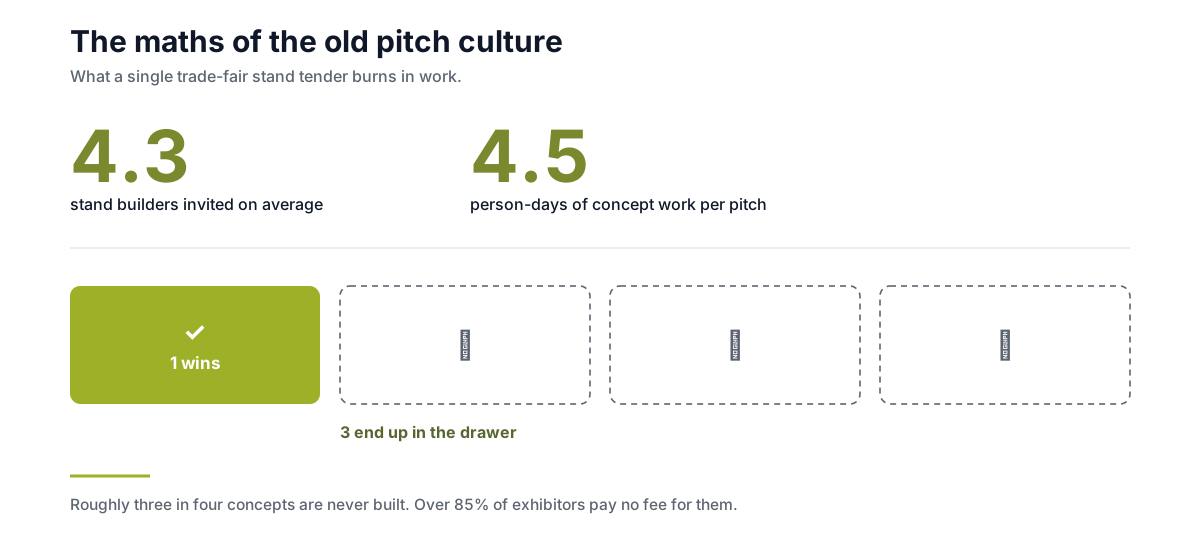
Only one can win. The success rate is 1 in 4, that is, around 24.8 per cent. Three out of four concepts are therefore created for nothing and end up unused in the drawer. This work is almost never paid for: 62.3 per cent of stand builders are "never" remunerated, another 35.1 per cent only "rather rarely". Over 85 per cent of exhibitors confirm that they pay no pitch fee as a rule. Three out of four stand builders have come to terms with this situation and take part, on average, 24 times a year in a tender without payment.
That is the bill of the old pitch culture: a large part of an entire industry's creative work is produced in order to be thrown away immediately.
Why this happens: whoever can't brief wants to see pictures
The obvious question is: why do exhibitors do this? Why commission five stand builders when four of them work for nothing?
The answer lies in another figure from the study. 40 per cent of all briefs, in the stand builders' view, fail to rise above "poor" or "adequate". The tender documents are thin: barely any information on objectives, on the target group, on the communication concern. And 60 per cent of stand builders say the number of such tenders has even increased in recent years.
Here the circle closes. Writing a good brief requires a company to know what it wants to achieve at the fair, whom it wants to reach and with what. That is precisely what many cannot do. The part that fails most often is the question of which products and exhibits belong on the stand at all. And whoever can't brief helps themselves differently: they'd rather have several finished designs made straight away and decide, in the end, on the basis of what looks best. The pitch replaces the brief that no one can deliver. Instead of clarifying beforehand what the stand should achieve, one looks afterwards at five pretty pictures and points at one.
The expensive fallacy: a nice picture is no proof
And here lies the actual mistake, bigger even than the wasted person-days. A design that pleases is not a design that works. The nicest picture wins the pitch, but no one has checked whether the stand behind it does the right thing: whether it addresses the right target group, carries the right message, pursues the right objective.
One decides on taste, not on effect. And because the decision rests on the picture and not on a strategy, no one after the fair is in a position to say whether the appearance paid off. The study puts exactly this insight in its conclusion, and it reads almost like an anticipation of what is needed today: concept and idea must be separated from production and execution. First there needs to be a viable base concept that clarifies the uncomfortable questions: What do we want to achieve? How do we measure success? What does the competitive environment look like? Only after that does it make sense to talk about the stand.
That separation did not happen back then. It still, for the most part, does not happen today.
What is changing now
At this point a development comes into play that shifts the picture. The wish that drives all the waste is: "I want to see a few designs to choose from before I decide." Until now, the only way there was to invite several stand builders and have them create concepts unpaid.
That is no longer the only way. Companies can generate these first pretty pictures themselves today, in an hour, with the available AI tools. Whoever wants to see five variants to get a feel for the direction no longer needs five stand builders investing 4.5 person-days each.
That is, seen correctly, good news, not least for stand builders. One often hears the worry that AI makes the design superfluous and the profession along with it. That worry falls short. AI generates a picture, it doesn't generate a buildable stand. It doesn't put proportions in order, it knows no statics, it doesn't know what can be realised within budget and time. For the step from the pretty picture to the standing stand, the stand builder is still needed, the one who says how an idea can be brought into reality and what it costs.
What disappears is not the stand builder. What disappears is the unpaid concept treadmill beforehand. The stand builder's role shifts from producing any number of throwaway designs towards being the one who turns an existing idea into something built. That relieves an industry that, as the study shows, has over years grown used to a structural self-exploitation.
The question that remains open
One thing this development does not solve, however. An exhibitor who generates five nice pictures in an hour and points at the nicest has made exactly the same mistake as in the pitch of ten years ago, only faster and cheaper. The picture is easier to obtain. The question of whether it serves trade fair success is thereby not answered one bit.
Because the real work was never the picture. The real work is the clarification beforehand: what are we here for, whom do we want to reach, what do we convince them with, how do we measure whether it worked. Whoever skips these questions gets, with AI, the same result as with five invited stand builders, a pretty stand with no guarantee of effect, only produced more efficiently.
In that sense AI clears away the resource waste of the old pitch culture, and that is real progress. The underlying problem it does not clear away. That stays where it always was: with the question of whether a company knows what it actually wants at the fair. We will take up exactly that question in a separate article.
Would you like to read the complete study on pitch culture in trade fair construction? Simply drop us a short email at messecode@fairconcept.de and we'll send it to you.
FAQ: Pitch culture in trade fair construction
When and on what basis was the pitch culture study produced?
The study was created more than ten years ago as a snapshot of pitch culture in the German trade fair construction market. It surveyed 156 stand-building companies, which together build 2.4 million square metres of stand space per year, and 218 exhibiting companies via online questionnaires. Despite its age, it depicts a pattern that has barely changed to this day.
What is the core problem of pitch culture in trade fair construction?
Exhibitors invite, on average, 4.3 stand builders per tender, each invests around 4.5 person-days in a concept, but only one wins the contract. Three out of four concepts are created for nothing, and over 85 per cent of exhibitors pay no fee for them. This creates a considerable, structurally ingrained waste of resources.
Why do companies invite so many stand builders?
Because many companies cannot produce a viable brief: 40 per cent of all briefs, in the stand builders' view, fail to rise above "poor" or "adequate". Whoever can't brief wants to see finished designs instead and decides on the basis of the picture that pleases most. The pitch thus replaces the brief that cannot be delivered.
Why is deciding on the basis of pictures a problem?
Because a design that pleases is not the same as a design that works. One decides on taste rather than effect, without having clarified whether the stand carries the right target group, message and objective. After the fair, it is then impossible to say whether the appearance paid off.
Does AI make the stand builder superfluous?
No. AI can generate pretty pictures, but no buildable stand. It doesn't put proportions in order, knows no statics and doesn't know what can be realised within budget and time. Turning an idea into reality still needs the stand builder. What AI makes disappear is the unpaid concept work beforehand, not the profession.
Does AI solve the underlying problem of pitch culture?
No. AI clears away the resource waste because companies can generate designs themselves instead of having five stand builders work unpaid. But whoever quickly makes a nice picture and points at it has made the same mistake as in the classic pitch. The real work, the strategic clarification before the picture, remains.