Most trade fair appearances talk about themselves: "market leader", "30 years of experience", "innovative solutions". But the visitor asks only one question: and what's in it for me? Value argumentation answers exactly that, in a clear chain: from feature, through advantage, to benefit, and one step further that almost everyone skips: to proof. This article shows the FAB+T logic (Feature, Advantage, Benefit, Trust) applied to the three places where it counts at a trade fair: the stand conversation, the stand graphics and the pitch text. Because a benefit you claim but cannot prove is worthless at a trade fair.
"We are leading." And then?
Walk through any trade fair and read the stand back walls. You'll find the same sentences everywhere: "Your reliable partner." "Quality since 1985." "Innovative solutions for your challenges." "We move what moves you."
These sentences have one thing in common: they are about the exhibitor. About their size, their history, their self-image. And they leave the visitor with the very question they arrived with: Good for you. But what's in it for me?
That isn't a wording problem, it's an error in thinking. Most exhibitors argue from the inside out: they say what they are and what they have. But the visitor thinks from the outside in: what does this solve for me? Between those two perspectives lies the entire difference between an appearance that works and one that was merely expensive.
The good news: the way from inside-out to outside-in isn't a matter of talent or creativity. It's a method. And it has a name.
The chain: feature, advantage, benefit. And the step everyone forgets
In sales, the FAB formula is a classic: Feature, Advantage, Benefit. From the attribute, through the advantage, to the benefit. It's good, but it stops one step too early. In the MesseCode we therefore work with FAB+T. And the +T is the decisive part.
The four links of the chain:
- Feature: what is it, concretely? The bare attribute, without marketing language. Not "innovative", but the thing you can measure, show, touch.
- Advantage: what does it make possible? The functional advantage that follows from the attribute. What becomes faster, easier, safer?
- Benefit: why is that relevant to this person? The concrete benefit for the human standing in front of you. This is where relevance is created.
- Trust: how do you prove it? The evidence: reference, figure, certificate, live demonstration, track record.
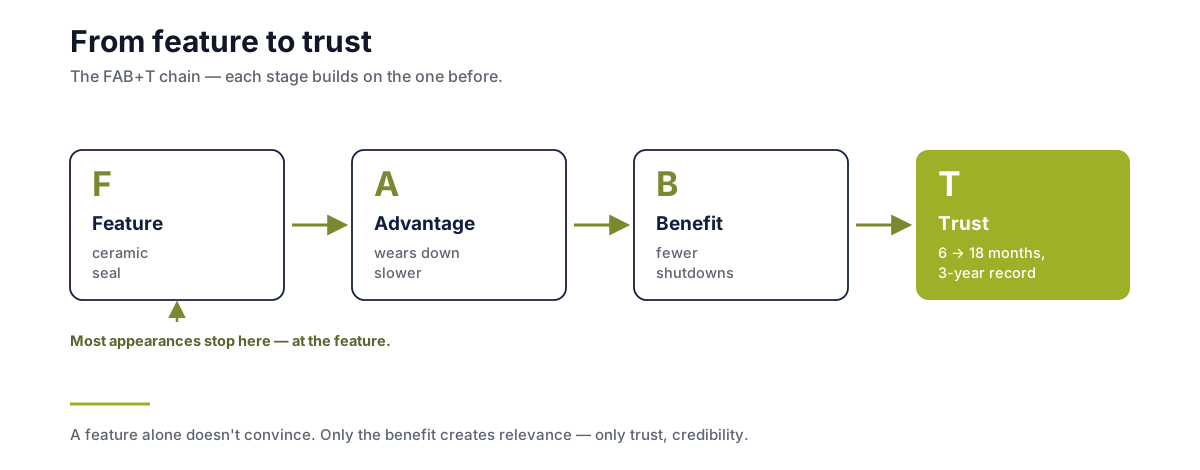
Let's play it through with an example. Take a manufacturer of industrial pumps, a feature most would treat as a finished selling point:
- Feature: the pump has a ceramic-coated mechanical seal.
- Advantage: as a result it wears down far more slowly than a standard seal and has to be replaced less often.
- Benefit: for the operator that means fewer unplanned production shutdowns, so lower downtime costs and calmer nights.
- Trust: a plant operator from the same industry reports that maintenance intervals have stretched from six to eighteen months, documented over three years.
Read the four stages again and notice what happens. "Ceramic-coated mechanical seal" interests no one but an engineer. "Fewer unplanned shutdowns" suddenly interests half the plant. And the three-year track record turns a claim into a verifiable statement. Same pump, same seal. But only at the end of the chain has it become an argument.
Most exhibitors stop at stage one. They hang the feature on the wall ("Ceramic seal!") and wonder why nobody stops.
Why the +T decides everything
The benefit creates relevance. But relevance alone isn't enough at a trade fair, because the visitor hears the benefit at every second stand. "Lower downtime costs", "more efficiency", "greater safety" are promised by half the hall. The question that really counts in the visitor's head isn't whether you claim a benefit, but whether you can prove it.
This is exactly where the professional appearance parts ways with the interchangeable one. A benefit without proof is a claim. A benefit with proof is evidence. And evidence is what trust attaches to: the real currency of a trade fair.
It's also the answer to the industry's favourite objection: "But you can't grasp trust." Yes, you can, by tying it to evidence. The Trust part forces you to answer, for every benefit: how does the visitor know this is true? Whoever can't answer that has no argument, only a wish.
And a practical note that often gets lost in the bustle: benefit and proof must stay cleanly separated. "Our particularly reliable pump saves costs" mixes the two and proves nothing. "The pump saves costs (benefit). An operator documented this over three years (trust)." separates cleanly. And only then does the chain hold.
The same advantage, two people, two benefits
Now comes the point where a formula becomes craft. Because the benefit is not the same for everyone. Whoever stands in front of your stand decides which benefit counts.
Let's stay with the pump and its long-life seal. Two different people can be standing at the stand:
- To the technical director you sell the benefit of process reliability: fewer unplanned shutdowns, plannable maintenance, no trouble with the maintenance team.
- To the managing director you sell the same feature, but the benefit of risk reduction and cost control: calculable operating costs, no production loss that ruins the quarterly figures.
Same feature. Same advantage. Two completely different benefits, because two completely different people with two different fears are standing in front of you. Say the same sentence to both and you reach one at best.
And here is the point on which the whole chain stands or falls: a benefit is always the answer to a pain. "Fewer unplanned shutdowns" is only a benefit because unplanned shutdowns are the technical director's pain. "Calculable operating costs" is only a benefit because uncalculable costs keep the managing director awake at night. Without the pain there is no benefit, only an attribute that interests no one. The argument chain is therefore not derived from the product, but from the target person's pain. Whoever doesn't know the pain can only guess the benefit.
That is precisely why, in the MesseCode, argumentation is developed not for the product but for the decision-maker role (in the Playbook, the IVP, the Ideal Visitor Profile). And the real groundwork isn't the feature list, it's the pain analysis: which challenge drives this person, which risk do they want to avoid? These pains are the raw material from which benefits can be derived in the first place. Whom you want to address, how you recognise them and, above all, what really troubles them is clarified by defining your ideal customer. Without that step you argue into the void: technically clean, but past the wrong person and their real pain.
Three places, one chain: conversation, graphics, pitch
The beauty of FAB+T is that a chain, once worked out, functions at every touchpoint. It only changes format. Three places where it counts at a trade fair:
The stand conversation. Here the chain runs out loud and in seconds. Most people's mistake: they start at the feature ("We have our new series here with…") and lose the visitor before the benefit arrives. Turn it around. Enter at the problem the benefit solves ("How often does a plant stand still unplanned at your site?") and lead backwards through the chain from there. The Trust part is strongest in conversation, because you can deliver it live: name the reference, show the figure, demonstrate the exhibit.
The stand graphics. Here you have two seconds and a handful of words. There's no room for the full chain. So the graphics show the benefit, not the feature. Not "ceramic-coated mechanical seal", but "18 months without a maintenance stop". The person explains the feature in conversation; the proof stands as a figure beside it. Stand graphics are where most chains die, because out of convenience the feature ends up there instead of the benefit.
The pitch text. Whether a talk abstract, an exhibitor directory entry or a LinkedIn announcement: the pitch is the chain in written form, condensed into a few sentences. The same order applies: problem, benefit, proof. And the feature only as far as it supports the proof. A pitch that begins with "We are a leading provider of…" has already lost the first and most important second to the inside-out view.
One chain, three formats. Whoever has built it cleanly once plays it everywhere: consistently, which itself strengthens trust, because visitors hear the same story at every touchpoint.
The exhibit: making the benefit tangible, or just showing the feature?
There is a fourth place, and it's the most expensive: the exhibit. And it's precisely here that the most consequential error happens.
"We have to let people see the plant running". You hear this sentence at every industrial trade fair. It sounds like proof, like trust. But it's usually the opposite: feature communication writ large. Because what does the running plant prove? That it runs at the trade fair. Not that it runs eighteen months without maintenance, starts up quickly in the morning, consumes little. The benefit that actually matters is simply invisible in live operation, because it shows itself over time, cost and reliability, not in five trade fair minutes.
That's the misconception: the running machine shows the feature ("it works"), not the benefit ("it spares you unplanned shutdowns"), and certainly not the trust ("and the reliability curve over three years proves it"). Sometimes a chart beside the machine proves more than the machine itself.
This turns the question you ask every exhibit into a different one. Not: does it run? Not even just: does it pay into the objective? But: which link of the FAB+T chain does this exhibit make tangible, and which one not? An exhibit that only shows the feature has done half its job. Only when it makes the benefit palpable or the trust verifiable does it hold. That's why, in the MesseCode, an exhibit is tested against two measures: against the objective and against the argument chain.
That is exactly the job of touchpoints: they make the value argumentation tangible. Which touchpoint carries which part of the chain, and what actually needs an exhibit, is the subject of touchpoints at the trade fair stand. Level 5 delivers the argument, Level 6 makes it experienceable. And the exhibit is only worth its money if it proves something at that seam.
The five mistakes that make value argumentation fail
When argumentation doesn't work at a trade fair, it's almost always down to one of these five patterns:
Phrases instead of features. "Innovative", "high-quality", "tailor-made" aren't attributes, they're judgements. A feature is concrete and verifiable. Whoever waffles at the feature stage can't build a load-bearing chain.
The benefit stays general. "More efficient", "better", "future-proof". Everyone promises that. A benefit only holds once it's concrete enough that a competitor couldn't say exactly the same thing.
Trust is missing or stays implicit. The most common and most expensive mistake. The benefit is claimed but never proven. "Trust us" isn't trust: it's the absence of trust.
One argument for all. The same claim for the buyer, the engineer and the managing director. Each role seeks a different benefit. One sentence for all reaches no one.
Too many lines. Whoever has fifteen arguments has none. The art is prioritisation: the strongest one to three chains per target person, not the most. Argumentation wins through focus, not through volume.
The test: one chain in four lines
Let's make it verifiable. Take your most important selling argument and write it in four lines:
- Feature: what is it, concretely, without a single marketing word?
- Advantage: what does it make possible, easier or faster?
- Benefit: why is that relevant to this one decision-maker role?
- Trust: how do you prove it (figure, reference, demonstration)?
If one of the four lines stays empty, you don't have an argument, you have a building site. Missing the feature, you speak in phrases. Missing the benefit, you talk about yourself. Missing the trust, you talk into the blue. Only when all four lines stand (and the third is written for the right person) do you hold an argument that carries at a trade fair.
And then comes the real work, which stays the same as for the whole appearance: not to build the most chains, but to choose the few strongest.
What remains
A trade fair appearance doesn't convince because it shows how good the company is. It convinces because it proves what the visitor gets out of it. The way there isn't a question of creativity, but a chain: from the concrete attribute, through the advantage, to the role-specific benefit and (the step almost everyone forgets) to the proof.
Features convince no one. Advantages may impress. Only the benefit creates relevance. And only trust turns it into something the visitor believes. That's the difference between a stand where a lot is on display and one where something is understood.
And whoever has read the previous articles recognises the pattern at this point: argumentation (Level 5) doesn't stand alone. It's derived from the offering (Level 3) and the pains of the ideal customers (Level 4), it's made tangible through the touchpoints (Level 6), and in the end it pays into the objective (Level 1). No building block carries alone. That's the idea behind the MesseCode: not seven good individual measures, but a system in which each level supports the next and a mistake on one level undermines all the following ones.
Where your argumentation stands today is shown by the Strategy Test in five to ten minutes: seven levels, no sign-up, no obligation. The full method, including the FAB+T worksheets for Level 5, is in the MesseCode Playbook. And how the argumentation becomes tangible at the stand is shown in the article on touchpoints at the trade fair stand.
FAQ: Value argumentation and FAB+T at the trade fair
What is value argumentation?
Value argumentation is the art of explaining an offering not through its attributes but through the concrete benefit for the customer. Instead of saying what a product is or has, it shows what the customer gets out of it. At a trade fair this is decisive, because visitors decide in seconds whether an offering is relevant to them, and attributes alone don't answer that question.
What does FAB+T mean?
FAB+T stands for Feature, Advantage, Benefit, Trust: an argument chain in four stages. Feature is the concrete attribute, Advantage the functional advantage, Benefit the concrete value for a specific person, and Trust the proof that makes that value credible. The classic FAB model from sales ends at the benefit; the +T (Trust) adds the evidence, at a trade fair, the decisive step.
Why aren't features enough to convince?
Because a feature only describes what something is, not what it means for the visitor. "Ceramic-coated seal" says something to an engineer, to no one else. Only the translation into a benefit ("18 months without a maintenance stop") makes the attribute relevant. Features are the starting point of the argument, not its goal.
What is the difference between advantage and benefit?
The advantage is the functional advantage that follows from an attribute (the seal wears down more slowly). The benefit is why that is relevant to a specific person (fewer unplanned shutdowns, calmer nights). The advantage is still product-related; the benefit is person-related, and only the benefit convinces.
Why is the Trust part so important?
Because at a trade fair every second stand promises the same benefit. "More efficiency", "lower costs" the visitor hears everywhere. The difference comes from the proof: a reference, a documented figure, a live demonstration. A benefit without proof is a claim; a benefit with proof is evidence. And evidence is the foundation of trust.
How do I apply FAB+T in the stand conversation?
Don't start at the feature, but at the problem the benefit solves. Ask a question that opens the need, and lead through the chain from there. You deliver the Trust part most powerfully live: name the reference, show the figure, demonstrate the exhibit. And adapt the benefit to the role of the person opposite. The engineer and the managing director seek a different benefit.
Does a running exhibit prove trust?
Usually not. A running plant shows that it works at the trade fair, that is, the feature. It doesn't prove the actual benefit, which shows itself over time: that it runs reliably for months, consumes little or starts up quickly. This trust often comes not from the exhibit itself, but from a piece of evidence beside it: a documented figure, a reference, a reliability curve. An exhibit should therefore be tested not only against the trade fair objective, but against the argument chain: which link does it make tangible (the feature, the benefit or the trust)?