Hardly any industry questions its own existence as persistently as the trade fair industry. „Does the trade fair still pay off?" You hear it everywhere: at industry conferences, in webinars, from service providers, from exhibitors themselves. Yet the problem isn't the trade fair. It's the question. Grown-up marketing channels don't debate whether they are needed. They debate how to do them better. The trade fair, by contrast, slides straight into the existential question. Many hold it to be ineffective. The reason lies elsewhere: we never learned to put a figure on its value. This article shows why the question is wrong, why the value of a trade fair can in fact be calculated, and which three questions we should be asking instead: about clarity, about value, and about capability.
Grown-up channels don't debate their existence
Of course, someone occasionally asks whether LinkedIn „still pays off" or whether a website „does anything at all". These channels are often played badly too. But the difference is decisive: website, SEO and social media share a common measure and a culture of optimisation. There, you debate the application: how do I get found, what converts, what do we optimise next. The trade fair debates its existence.
And that is remarkable, because we are not talking about a niche channel. For exhibiting companies in Germany, the trade fair is, according to AUMA, the second most important marketing instrument, right after their own website, with an importance rating of around 78 percent. Depending on the year and segment, a good third to nearly half of the marketing budget flows into trade fairs; among small companies and in retail, the share is sometimes around 50 percent.
That very order of magnitude explains why, of all channels, the trade fair doubts itself. With LinkedIn or a website, „not worth it" is a small lever: the channels cost little, the verdict has few consequences. A trade fair, by contrast, is quickly a six-figure item. Cut it, and you free up budget for other things at a stroke, you look thrifty, and you are even praised for the supposedly clever decision. That makes the verdict „not worth it" seductive. It seems to pay off immediately. Except: as long as no one can calculate what the trade fair actually delivers, „we're saving the money" is not a good decision. It only looks like one.
The perennial question is therefore a symptom. And whoever follows it does not arrive at a defect of the trade fair, but at us, at the way we play it. At its centre sits a single error in thinking: that the real value of a trade fair (encounter, trust, relationship) cannot be calculated. It can. And as long as we believe the opposite, we talk about existence instead of craft. This text removes exactly that error.
Where the doubt comes from: the borrowed verdict
Ask where the conviction comes from that trade fairs no longer pay off, and almost always two sources emerge. The first is one's own experience: „Our last trade fair somehow wasn't that good." The second is the big players: „If even such-and-such a corporation no longer attends, that must mean something."
Both feel like proof. Neither is. Two mechanisms are at work. Confirmation bias describes our tendency to search not for the truth but for confirmation of what we already believe: whoever thinks trade fairs are losing relevance sees the proof in every cancellation. And social proof makes us treat the behaviour of big names as correct, especially when we have no clear opinion of our own. A major corporation cancels a trade fair. And the industry follows it like a herd, without knowing the decision.
Yet the close look is worth it. When a large exhibitor cancels a trade fair, it doesn't say „trade fairs don't work". It says: „This trade fair, under these conditions, doesn't work sufficiently for us." That is a mature decision: measured, evaluated, compared. We hear something else, however, and turn a well-founded individual decision (whose objectives, figures and alternatives we don't even know) into a blanket judgement about an entire instrument. We adopt a verdict from a process we were never part of.
A borrowed verdict is not a finding. And the question „Does the trade fair pay off?" remains unanswerable for as long as we have no common measure against which to answer it.
Value is created in context. And value needs a currency
A bottle of water costs 40 cents in the supermarket. At the train station on the way to the airport, it's 2.50 euros. Before the security check, 6 euros. And beyond it, once they've just taken your own bottle off you, 8.50 euros. The same water, the same brand, the same thirst. Only the place has changed. And with it the price you pay without complaint.
Value is not created in the product. Value is created in context and in experience. The trade fair is an experience too; the only question is which one, for whom, and who ensures it becomes one worth the price. And that price is real: noise, a crowded hall, long days, the journey, the cost. You only accept it when the benefit carries the sacrifice. Whether it does is not a matter of feeling. It's a calculation. And to calculate, you need a currency.
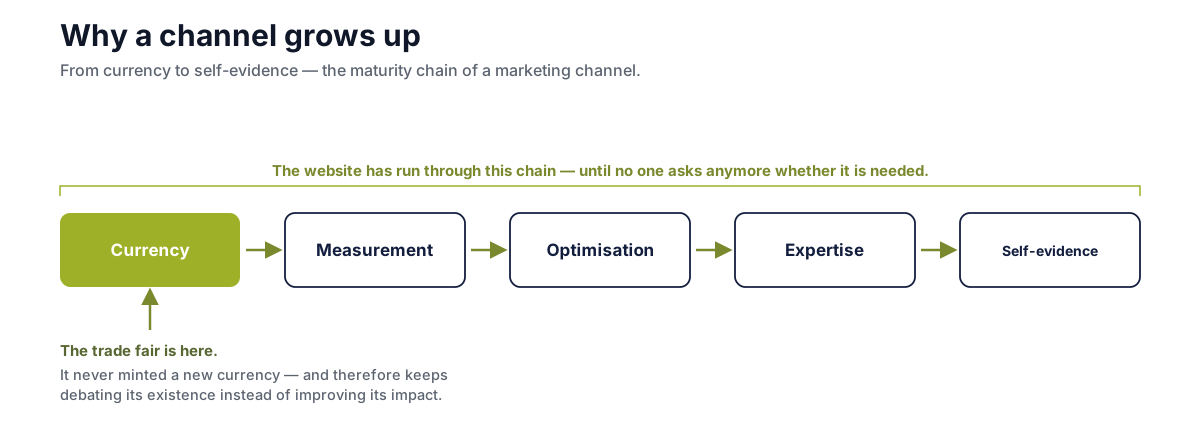
Here lies the real difference between the website and the trade fair. The website brought its currency from day one: clicks, reach, conversions. Online had to prove what worked from the very first day. Measurability produced optimisation, optimisation produced expertise, and expertise produced the self-evidence that no one asks whether you need a website anymore, only how to make it better. The trade fair once had a currency too: revenue. Trade fairs used to be order fairs; you wrote contracts right at the stand. Those orders barely exist anymore. What remains is encounter, trust, relationship: all the things because of which we ourselves claim the trade fair is „hard to measure".
And whoever has no currency cannot put a figure on their value, cannot optimise, builds no expertise, and ends up debating existential questions.
The interesting part: of all players, the largest professional platform in the world is confirming the trade fair's currency anew. With its focus on creators and quality, LinkedIn itself concedes that reach and attention are no longer enough, that trust is needed. Trust is precisely the currency the trade fair has always had. The only difference: online, trust builds over many months and many posts. At a trade fair, it builds in an afternoon. We are not short of value. We are short of the courage to sell the trade fair with its strongest argument, and of the currency to prove it.
The buyer has long moved on. The appearance hasn't
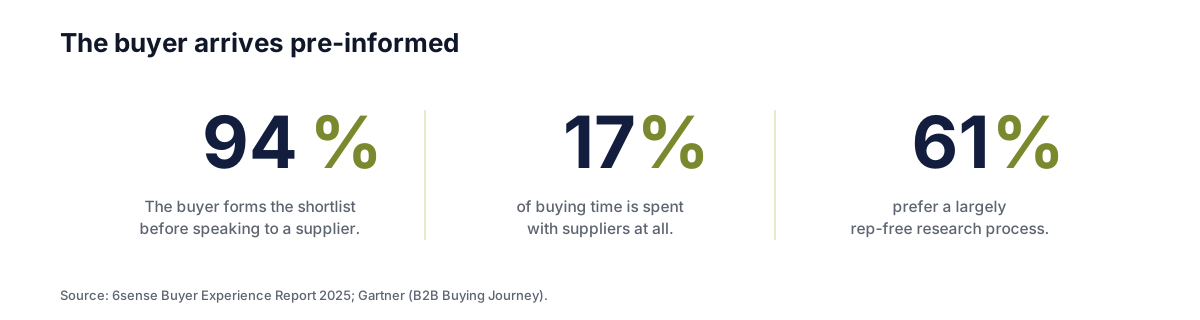
Why does the old stand logic no longer work? Because the buyer has changed and the appearance hasn't. Today's B2B buyer arrives pre-informed: according to 6sense, 94 percent of buying groups have formed their shortlist before speaking to a supplier for the first time; around two thirds of the buying journey is over before the first sales conversation takes place. Gartner adds that B2B buyers spend only 17 percent of their total buying time in conversations with potential suppliers at all, and that 61 percent now prefer a largely rep-free process. So the visitor doesn't come to the stand to hear about you for the first time. They come to validate, to compare, to test trust and to confirm a preference they have already formed.
It's worth taking this in soberly, because it contains an enormous opportunity: no other channel serves up the target group the way the trade fair does. A pre-qualified audience that comes with a concrete problem, at a fixed point in time, to a known place. You can't get a target group delivered more conveniently today. You only have to interlock the appearance with the needs of these people, instead of continuing to put the product in the middle.
Because that is exactly what most do. Yet the visitor sees the product everywhere. And the visitors at a stand are anything but alike: one has long known the product and only needs trust in the people behind it. The second already has it and wants service. The third doesn't understand which problem you solve at all, and walks past. Three completely different briefs for the same appearance. Treat them all the same and you reach none. Whom you want to address and how you recognise them is a question of defining your ideal customer, not of stand design.
And here a second force comes into play that the pre-informed buyer gets nowhere else: serendipity, the happy accidental find. Whoever researches digitally mostly sees what they were already looking for: search algorithms and feeds optimise for confirmation. The trade fair is the place for the opposite: the supplier who wasn't on the shortlist, the solution at the neighbouring stand, the conversation no one had planned. So the trade fair serves both sides of the same coin: the one who is looking for you on purpose, and the one who finds you by chance. No algorithm delivers that.
One caveat, though: serendipity is not chance across just anyone. The happy find is the visitor who wasn't on your list but has the same problem as your ideal customer. They swim into the same net. And that net is your positioning: the very signal that confirms the pre-informed visitor's hunch is what catches the accidental one too. The net doesn't grow when you get broader, it grows when you get sharper.
But even those who have made it onto the shortlist aren't home yet. Now consistency counts. What does the website say, what does the LinkedIn profile, what does the trade fair stand, and what does the employee standing on it? Do they all tell the same story, or each their own version? Many decision-makers report exactly such contradictory messages across channels, and contradiction irritates and costs trust. That, however, is not a trade fair problem but a strategic positioning problem that the trade fair merely makes ruthlessly visible, because there all channels converge in one person: the human being at the stand. Which brings us back to positioning, market presence and competitive environment, and to the question that really counts.
So not whether, but how: three questions
Take that seriously, and the whole debate shifts. The right question is not „Does the trade fair pay off?" but: which strategic function should the trade fair take on within a buying journey that is already well under way, and how do we measure it? A grown-up channel debates its application. And in doing so, we as an industry run into three questions to which we still have no good shared answer: clarity, value and capability.
Clarity: why so many appearances are interchangeable
Bad doesn't mean ugly or too cheaply built. Bad means interchangeable. And a considerable share of trade fair appearances stays below its potential for exactly that reason: hardly anyone can say in one sentence why a visitor should come to them and not to the stand next door. And hardly anyone can say what that visitor should tell others about the appearance the next day. Which single touchpoint at the stand answers that question (and which should be cut) is covered in Touchpoints at the Trade Fair Stand.
The reason is structural. No one lets the graphic designer develop their Google Ads strategy: visuals yes, but the strategy is done by a professional. In the trade fair world, the strategy is surprisingly often done on the side by half a marketing role, a salesperson or the boss. Or the brief is: „Stand builder, sort it out." The stand builder usually isn't a strategist either. Honestly, he's just the most competent player in a weak field. The trade fair has become highly complex, and value is created in context. You can't do that on the side. The consequence: the stand eats half the budget and gets a hundred percent of the attention. „Nice stand!" Nice is a matter of taste; whether it worked, no one knows. The stand is the substitute currency we celebrate, because we never minted a real one after revenue.
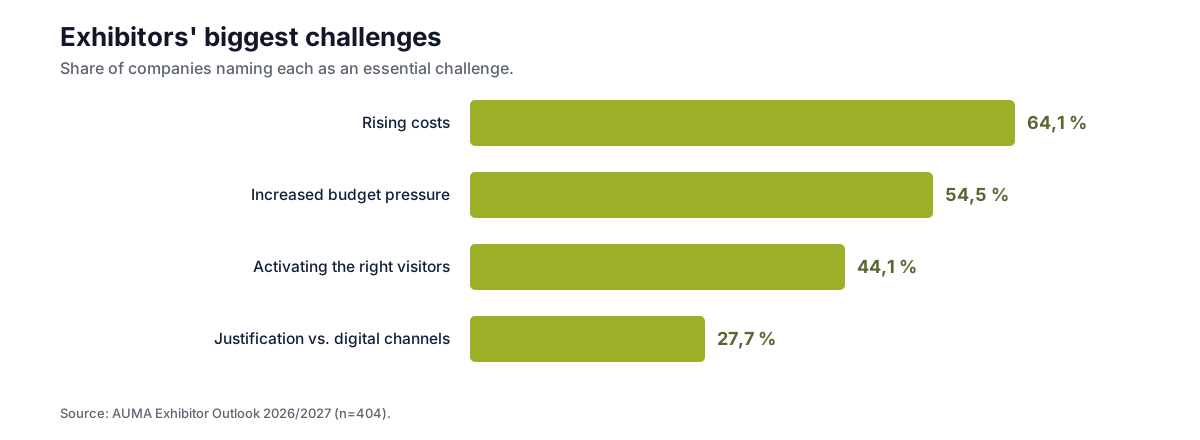
The circle closes with a figure that is uncomfortable: 44.1 percent of exhibitors now name winning and activating the right visitors as one of their essential challenges (AUMA Exhibitor Outlook 2026/2027). Nearly half of exhibitors cannot reliably get the people they are there for to their own stand. That is the proof of the thesis: these appearances aren't ugly and aren't cheaply built. They simply don't work. Because if the stand were doing its job, this would not be one of the industry's biggest worries. What has to be clarified before the stand, so that it holds, is covered in a separate article: What must be clarified before the trade fair concept.
Value: it can be calculated. You just have to dare
The most common objection is: „The trade fair is too expensive." And yes, costs have risen: 64.1 percent of exhibitors name rising costs as their biggest challenge, and 54.5 percent see themselves under increased budget pressure (AUMA Exhibitor Outlook 2026/2027). Right after it comes the second reflex, usually from online marketing: „I can get a lead far more cheaply digitally than at a trade fair." Both are true, and both compare apples with pears. Because costs are only a problem without counter-value, and a lead is not simply a lead.
Let's start with the charge that the trade fair pays into too many things to be calculated: new customers, distribution partners, recruits, community, branding, product demos. This very multifunctionality is treated as proof of unmeasurability. In truth it is the opposite. Because each of these effects ultimately consists of a human interaction, it can be captured: who spoke with whom about what, who attended the demo, who was at the evening event. That is not a question of whether, but of the granularity of your lead management. The calculation is only ever as good as the recording behind it: whoever doesn't assess leads at all can't complain that the trade fair is „not measurable" either.
So let's begin with the easy half, the costs. Suppose a trade fair lead costs 800 euros and a LinkedIn lead 40. On paper an open-and-shut case. Except: the LinkedIn lead starts cold and right at the top of the funnel. By the time it has been enriched, called, qualified and brought to a demo (which gets postponed and then happens after all), time and cost add up stage by stage. The trade fair lead arises directly in a personal, face-to-face conversation, further down the funnel, with a person who has buying influence. So the honest question isn't „what does a lead cost?" but: what would it cost to reach the same lead (at the same funnel and trust stage) through another channel? That is the substitution value of the lead. Sometimes it's higher, sometimes lower, but only this comparison is honest. How to rate contacts by funnel stage, and which figures are enough to do it, is set out in How do you measure impact?
And this is exactly where the supposedly unmeasurable becomes calculable: trust. Trust is a position in the funnel: from a certain stage on, someone begins to trust you. Online you reach it over months of silent readership and many posts; that costs money too, just diffusely spread. At a trade fair, the same stage is reached in an afternoon. Whoever knows the funnel stage of their leads can therefore put a figure on what the jump there would have cost elsewhere. Trust is not an excuse for unmeasurability. It is a funnel stage. And funnel stages can be quantified. The same logic applies beyond the individual lead: a single trade fair day replaces an average of 5.1 individual trips per visitor, according to AUMA; 61 percent of business contacts could not have been made digitally at the same quality; and according to the Freeman Trust Report 2025, 95 percent trust a brand more after an in-person event.
Even that understates the calculation. Because a lead is not simply a lead: it matters which product it concerns, with what level of interest, and at which decision-maker level it arises. Trade fair leads should be segmented like any other. Above all, „cost-per-lead" so far only talks about acquisition, not about the value of the customer behind it. The moment customer lifetime value enters the picture, the judgement of lead costs shifts fundamentally: an expensive lead that turns into a long-term customer is cheap. We deliberately won't open that barrel here. It's enough to note that the honest calculation has considerably more headroom than raw cost-per-lead suggests.
And what is all this for? To answer, in the end, the one question this article began with: did this trade fair pay off? Substitution value and opportunity cost are not an end in themselves. They are the tool with which a trade fair participation can be evaluated. And that tool has existed for a long time: the AUMA MesseNutzenCheck sets exactly this against each other (the costs of a trade fair participation versus the costs of alternative marketing instruments) and calculates the efficiency: set objectives, plan the budget, calculate the benefit. Free of charge. Only: hardly anyone uses it.
That leaves the reflex „but branding and community can't be measured". Do we even have to accept that shoe? Branding is hard to measure on every channel, community too. No online channel has solved this problem. It has only stopped being ashamed of it. The fair stance is: calculate what can be calculated. Often even the calculable part already exceeds the investment. The rest (brand, community, the truly soft effects) comes on top and is just as hard to quantify elsewhere.
Because the truth is: the trade fair has no exclusive measurement problem. Every channel has it. Last-click attribution by definition assigns a hundred percent of the success to the last touchpoint, and Forrester notes that there is no perfect attribution model. Online turned this problem into an expert discussion: which model, which allocation, how do we optimise? We turned the same problem into an existential question. The same problem, two industries: one optimises, the other doubts itself. That this doubt is growing is shown by the AUMA outlook itself: 27.7 percent of exhibitors increasingly find themselves having to justify their trade fair participations internally against digital marketing instruments, precisely the debate we are having here.
Capability: who actually tells the exhibitors how?
That brings us to the most uncomfortable of the three questions. We don't have a knowledge problem: the answers have been on the table for years. We have a transfer problem. And part of it is remarkably convenient: as long as we say „you can't measure it", we don't have to deal with the far more uncomfortable question of why others play their channel more successfully than we play ours.
How transfer succeeds was demonstrated by the online world. SEO didn't get better because a search engine solved everything, but because an ecosystem grew up around it: agencies, trade media, conferences, certifications, communities. Only this ecosystem turned measurability into real capability. That is exactly what the trade fair lacks. Transfer is always the job of a system: organisers, associations, chambers, networks, educators, consultants, agencies. Everyone who is a multiplier to many companies.
A special role falls to the organiser, not as culprit, but as logical lever. For how is matchmaking supposed to work if the organiser doesn't know which problem an exhibitor solves for its customers, because the exhibitor doesn't know either? How is AI supposed to help if the fundamentals are missing? The organiser who thinks less about selling floor space and more about the success of its exhibitors wins twice over: successful exhibitors come back, bring visitors with them, justify budgets and tell success stories. Tellingly, this idea (the organiser as a full-service partner to its exhibitors, from matchmaking through to information brokering) is not new. Prof. Dr. Ralf T. Kreutzer described it back in 2007 in the AUMA edition „Messewirtschaft 2020". Nearly twenty years later, we are still discussing it as a vision of the future. It is not a vision problem. It is a transfer problem. How exactly this gap can be closed (and why the organiser is the one to do it) is explored in the article on Exhibitor Success.
„We already do all that": the comfortable pattern
At this point the sentence reliably comes: „We already do all of that." If we did, the patterns we see everywhere wouldn't exist: the interchangeable appearances, the unused tools, the borrowed verdicts. „We already do it" is the most comfortable sentence we know, because it allows us to change nothing.
And the sum doesn't add up in the long run, because the visitor has long been calculating along. It is no secret in the industry that visitor numbers recovered more slowly after the pandemic than exhibitor numbers. People like to explain that with travel restrictions and visa issues, and that is partly true. But it could also be that the need for information and communication has changed and that, for some, the trade fair is no longer worth its sacrifice. When the good people stay away, the value for exhibitors falls, and the circle closes. Yet the data shows the opposite of a dying species: the share of decision-makers among visitors is rising: 62 percent of organisers report more decision-makers, fewer but more relevant. And of all people, the young, digitally fluent generation (millennials and Gen Z already make up 71 percent of B2B buyers, according to Forrester) is said to be tired of presence. It is digitally saturated and therefore values genuine encounter all the more, provided it is relevant, interactive and credible.
From here, it is no longer a market question. It is a decision: repeat the pattern, or change it.
Three questions as a gift
Let's make it practical. The next time someone tells you the trade fair doesn't pay off (or you catch yourself saying it), ask three questions. First, clarity: why should a visitor come to you and not to the stand next door, and can you see it in your appearance? Second, value: how do you determine what the trade fair brings you, with real figures, the way online has long been able to? And third, capability: who is helping you do it?
Whoever answers these three questions cleanly and then says „not worth it for me" is making a real decision, like the corporation that cancels a trade fair. A trade fair is allowed not to pay off sometimes. But then as a finding, not as a borrowed excuse.
Because trade fairs do pay off. Of course, just like a website, like SEO, like LinkedIn. The question was never whether. The question was always: how well do we master our craft?
Imagine, for a moment, an industry that has stopped justifying itself. Where exhibitors don't ask whether the trade fair pays off, but how to do it better this year. Where organisers don't sell floor space, but success. Where (as has long been the case in online marketing) there is a common currency, shared standards and an ecosystem that turns measurability into real capability. That industry wouldn't be smaller than today. It would be indispensable. And the way there doesn't begin with more effort (the industry already brings that), nor with a bigger budget or a new hall. It begins with a common measure.
Where you stand yourself is shown by the Strategy Test in five to ten minutes: seven levels, no sign-up, no obligation. The full method behind it is in the MesseCode Playbook, and how the levels connect is shown on the pillar page developing a trade fair strategy. Whoever builds successful systems doesn't debate their existence. They improve their impact.
FAQ: Does the trade fair still pay off?
Does a trade fair still pay off today?
Yes, but not across the board. Trade fairs pay off when they are run as a late-stage, trust-building node within a buying journey that is already under way, with clear positioning and measurable benefit. „Whether" is the wrong question; the right one is which strategic function the trade fair should take on and how you measure success. A single trade fair is allowed not to pay off, but as a measured finding, not a borrowed verdict.
How do you calculate the value or ROI of a trade fair?
Via the value side, not just the cost side. Cost-per-lead alone is misleading, because a trade fair lead does not sit at the same funnel stage as a cold online lead. The honest question is: what would it cost to reach the same lead (at the same funnel and trust stage) through another channel? That is the substitution value. Add measurable effects such as avoided individual trips (an average of 5.1 per fair day, according to AUMA) and contact quality (61 percent could not be made digitally at the same level). The AUMA MesseNutzenCheck sets exactly these costs against alternative marketing instruments.
What is the AUMA MesseNutzenCheck?
A free software tool from AUMA that calculates the efficiency of a trade fair participation: set objectives, plan the budget, calculate the benefit. It compares the cost of a trade fair with that of alternative marketing instruments and has existed for years, yet is hardly used. That is the real problem: not a knowledge problem, but a transfer problem.
Why don't trade fairs work the way they did 40 years ago?
Because the buyer has changed and the appearance hasn't. The B2B buyer arrives pre-informed: 94 percent form their shortlist before the first supplier contact, and they spend only 17 percent of their buying time with suppliers (6sense, Gartner). The old order-fair logic (book space, product in the middle, wait) meets a visitor who already knows what they are looking for.
How do I tell whether a trade fair pays off for me?
By three questions. Clarity: why should a visitor come to you and not to the stand next door, and can you see it in your appearance? Value: how do you determine what the fair brings you, with real figures? Capability: who is helping you do it? Whoever answers these three cleanly can make a real decision, for or against the fair.
Isn't it more honest to say trade fair success can't be measured?
No. Branding and community are hard to measure on every channel: no online channel has solved it, it has only stopped being ashamed of it. The fair stance: calculate what can be calculated. Often even the calculable part exceeds the investment; the rest comes on top. Attribution isn't a trade-fair-specific problem either: last-click assigns a hundred percent to the last touch, and according to Forrester there is no perfect model anywhere.
Why does the trade fair industry of all industries keep questioning its own existence?
Because it lacks a common currency. The website brought its currency (clicks, reach, conversions) from day one; optimisation and expertise grew from that. The trade fair had the revenue of order fairs but never minted a new currency. Add the size of the budget: cancelling a six-figure fair looks like a clever saving, even though, without a calculation, it can't be a good decision at all.
What role does the trade fair organiser play in this?
A central one: as a lever, not a culprit. Matchmaking and AI only help if it is clear which problem an exhibitor solves for its customers. Organisers who think less about selling floor space and more about the success of their exhibitors win twice over: successful exhibitors return and bring visitors with them. The idea isn't new. Prof. Ralf T. Kreutzer described it back in 2007. It's a transfer problem, not a vision problem.