TL;DR
Most trade fair participations do not fail in the execution. They fail because the strategy has not been defined beforehand. And “strategy” is more precise than many people assume: the MesseCode clarifies seven levels that must be established before any investment is made (objectives, company and market position, offer, ideal customers, argumentation and touchpoints).
The first six levels are positioning work. Only the seventh brings everything together into a strategy: a tested system in which every decision is measured against the objective and supports the next decision. Work through this once and the result is not merely an answer for one trade fair, but a foundation for every future participation.
This article explains how the seven levels work together.
“We need a trade fair strategy.” The sentence is often heard only after something has gone wrong: the stand looked good, the conversations went well, and yet no one can say afterwards whether the investment was justified.
The usual response is to buy the next individual solution: a better stand, sales training or a lead tool. Each of these solutions may be right in itself. None of them is the strategy.
Developing a trade fair strategy does not mean choosing between these solutions. It means clarifying the level that comes before them: the level from which you can decide which of these solutions is actually the right one this time.
At fairconcept, we call this level the MesseCode: seven stages that should be clarified before any investment is made. This article guides you through all seven, both as an overview and as a map. Each individual level has its own in-depth article; as soon as it is published, we will link to it in the relevant section.
Why “strategy” is not what most people think it is
In day-to-day trade fair work, “strategy” is used to describe three different things, none of which is actually a strategy.
The first is a statement of intent: “We want to place greater emphasis on trade fairs in 2026.” That is a direction, not a system.
The second is the action plan: stand size, location, budget and staffing plan. That is execution, but it comes too early if the foundation is missing.
The third is an individual solution sold as strategy: the stand, the tool or the training programme. Each opens a genuine room, but none of them is the building.
A trade fair strategy is something different: a coherent system of decisions that must be clarified in a particular order, because each later decision builds on an earlier one. Anyone who defines the stand design before identifying the target audience is building on sand. Anyone who writes the argumentation before focusing the offer is arguing into a vacuum. Strategy is the sequence in which these questions are answered, and the final check that everything fits together.
This is an observation reflected in industry data. Trade fairs remain one of the most important marketing instruments for around 77% of companies, across all company sizes. At the same time, 10% of exhibitors do not measure their trade fair success at all, and 30% of briefs submitted to stand builders do not contain a single specific objective. The investment is therefore substantial and the relevance undisputed, yet the system that should come first is surprisingly often missing. A trade fair strategy closes precisely this gap.
Positioning and strategy. And the test that makes both visible
Before examining the individual levels, one distinction makes all the difference. fairconcept stands for “positioning and strategy”, and these are deliberately two different things.
The simplest positioning test does not require a presentation slide. Imagine meeting a visitor three halls away, half an hour after they left your stand. You casually ask where they have just been and what that company actually does.
There are three possible answers, and two of them are expensive. The first: the visitor repeats a wild story invented spontaneously by a salesperson at the stand (something documented nowhere and impossible to pass on consistently). The second: the visitor repeats a phrase heard at every second stand (“75 years of innovation” or “innovation is our passion”). Neither remains in the mind. The first exists only in that one conversation. The second could apply to almost any exhibitor in the hall.
The third answer is the only one that matters: the visitor describes something specific about your company in their own words, something accurate, memorable and worth repeating. Ideally, they also say what they intend to do next: call, request a sample or tell colleagues internally.
That is positioning: what the visitor says after leaving the stand, and what they then do. It is not a claim on the wall or a “big idea” in the brief. It is a specific, verifiable perception that remains in the visitor's mind when you are no longer there.
Strategy is the complete route to that outcome: the architecture that aligns everything (invitation, stand, touchpoints, team and follow-up) with that one perception and the intended action. The seven levels of the MesseCode are the method used to develop both.
The first six sharpen the positioning. They clarify who you are for whom, with which offer and on what grounds, and how that perception is genuinely created at the stand rather than merely decorated. It becomes strategy only at Level 7, when all decisions are brought together into a coherent system and tested against one another.
This distinction is not academic. It explains why a good individual measure can never replace a strategy, and why the success of a trade fair participation can be assessed through one simple question: does the visitor three halls away tell the right story?
The system: seven levels that build on one another
The MesseCode structures strategic work across seven levels. They follow a logic: each answers a question that must be clarified before the next can be addressed meaningfully. Early decisions shape later ones, and later insights may require earlier decisions to be corrected.
Strategy is therefore not a linear process completed once from top to bottom. It is systematic. You work through the levels, return to earlier ones and refine them until the system holds together.
The seven MesseCode levels form a heptagon: objectives, company and market position, product and service logic, ideal customers and decision-maker positions, argumentation architecture, trade fair logic and touchpoints, and overall strategic architecture. All seven levels are equally important and interconnected. What is decided at Level 1 affects Levels 5 and 6, and what becomes visible there may sometimes require Level 2 to be corrected. That is why the model is a heptagon rather than a staircase.
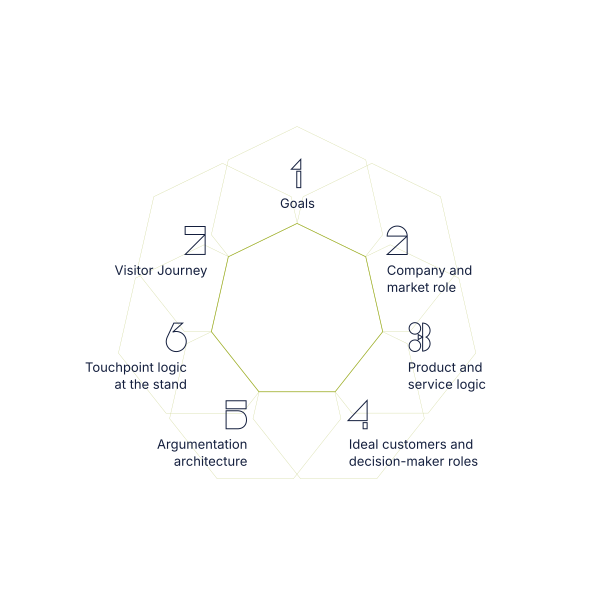
The seven levels at a glance:
- Objectives: What exactly should this trade fair achieve?
- Company and market position: From which position are you entering the event?
- Product and service logic: Which offers support the strategy?
- Ideal customers and decision-maker positions: Who exactly are you addressing?
- Argumentation architecture: What robust reasoning supports your proposition?
- Trade fair logic and touchpoints: How will all of this be experienced at the stand?
- Overall strategic architecture: Does everything combine to form a consistent system?
Level 1, Objectives: What exactly should this trade fair achieve?
Everything begins with the objective, and this is where most briefs already fail. “More leads, visibility and meeting existing customers” is not an objective. It is a list of good intentions.
A decision-ready trade fair objective can be verified, is linked to the company's business strategy and excludes what is not an objective. A list is reduced to exactly one primary objective, to which everything else is subordinate, including explicitly defined non-objectives.
This level is the foundation and, at the same time, the test for everything that follows. Every later decision is measured against this objective. A market position, an argument or a touchpoint matters only if it contributes to the primary objective. Without a focused objective, there is no standard against which the rest can be assessed.
The article Defining Trade Fair Objectives explains how this works in detail.
Before that comes the question of whether it is the right trade fair. It can be settled with two separate assessments, the quality of the fair and its strategic relevance, described in Which trade fair is the right one?
Level 2, Company and market position: From which position are you entering the event?
The second level compares self-perception and external perception, specifically in relation to the individual trade fair. A company's position is not fixed.
In one segment, you may be an established market leader with a high level of recognition. At the leading trade fair for that segment, visitors know you and your participation can build on that position. In another segment (perhaps one you are entering to diversify your portfolio) you may be completely unknown at the relevant trade fair. The same company, two trade fairs, two different positions.
This has practical consequences for the participation. A newcomer behaving like the market leader creates friction because the market does not accept the claim. A market leader behaving like a newcomer wastes the authority it already possesses.
The work at this level is uncomfortable because it demands honesty: how does the market perceive us at this specific trade fair, not how would we like to be perceived? Only when this picture is established can the company adopt a position that will hold up at the stand. That position becomes the lens through which every later statement is interpreted.
The article Company and Market Role shows how this level is worked through in detail, from comparing self-perception and external perception to the company profile for this specific trade fair.
Level 3, Product and service logic: Which offers support the strategy?
Not every product belongs at every trade fair. Anyone presenting the entire portfolio becomes difficult to categorise. In the few seconds available at the stand, visitors cannot understand what the company stands for.
This level creates focus: which small number of offers supports the primary objective and fits the market position defined at Level 2? The test is demanding because it removes something. An offer that does not contribute to the objective or weakens the positioning should not be on the stand this time, even if it is a good product.
This reduction is not a loss. It is the point. Focus is created through selection, not completeness. The focused offer is one of the three ingredients that come together in the argumentation at Level 5.
The article Which Products Belong on the Trade Fair Stand shows how this selection is made in practice, with three test questions and three categories.
Level 4, Ideal customers and decision-maker positions: Who exactly are you addressing?
In B2B marketing, the ideal customer profile, or ICP, has long been standard practice. At trade fairs, it is still rarely applied properly. “We talk to everyone who passes the stand” remains the norm. The result is a stand designed specifically for no one, and therefore reaching no one specifically.
This level defines not only which companies are the ideal customers, but also which decision-maker positions within those companies must be addressed. A technical buyer has different needs from a managing director. The real task is to identify and deliberately activate those needs: what matters to this person? What drives their decision? What will they respond to?
This is one area in which AI is now exceptionally strong. It can reveal need patterns and decision-making patterns within hours, research that previously required weeks and numerous conversations. It therefore enables a level of depth that manual research rarely achieves. This is one of the points at which strategic work is most significantly enhanced by AI.
These prioritised ideal visitor profiles and their needs (referred to as IVPs in the MesseCode) become the audience for everything that follows.
Level 5, Argumentation architecture: the core discipline
This is where the groundwork becomes tangible, and it is the core discipline of the MesseCode. Three levels come together:
- the focused offer from Level 3,
- the position from which the company is appearing, defined at Level 2,
- and the people and their needs, identified at Level 4.
The guiding question is: why should our ideal customers stop at our stand, listen to us and trust us rather than visit a competitor?
Within the MesseCode, the answer follows the FAB+T logic:
- Feature: what it is,
- Advantage: what it makes possible,
- Benefit: why it matters to this particular person,
- Trust: how we substantiate it.
The benefit and the evidence must remain separate, and the benefit must be formulated specifically for the decision-maker position, based on the needs identified at Level 4. The largest number of arguments does not win. The few strongest and clearly prioritised argumentation chains do. These chains are the heart of the entire strategy. Everything before this level feeds into them; everything afterwards puts them into practice.
Level 6, Trade fair logic and touchpoints: How does the argumentation become an experience?
The direction now changes. What was developed as an argument at Level 5 must become an experience at the stand. That is the guiding question at this level, not “Which elements should we place on the stand?” but: how do we translate the benefit argumentation into something visitors genuinely experience? A test, a specific offer or a real piece of added value.
The analogy with online marketing is obvious: the lead magnet. A benefit is promised in order to initiate contact. But many lead magnets are empty promises. People download something and know no more afterwards than they did before. That does not work at a trade fair. Anyone promising value and then failing to deliver it has not won the contact at the stand. They have lost it. A touchpoint must genuinely deliver its benefit. Otherwise, it is decoration with a label attached.
A touchpoint is any point at which a visitor encounters the company: stand graphics, the initial approach, the conversation, a demonstration, a test or an exhibit. The distinction is important: not every touchpoint is an exhibit, but every exhibit is a touchpoint. And every one of them is tested against the objective defined at Level 1. If a touchpoint does not bring you closer to the primary objective, it does not work, however attractive it may be.
This level also determines what the visitor will say about you three halls away. Touchpoints that deliver genuine value leave something specific and repeatable behind. Decoration leaves nothing.
At this level, the way in which the system fits together becomes visible: the touchpoint at Level 6 makes the argumentation from Level 5 tangible. That argumentation was derived from the company and market position at Level 2, the offer at Level 3 and the needs at Level 4. Everything together is measured against the objective at Level 1.
Level 7, Overall strategic architecture: where positioning becomes strategy
The seventh level does not develop anything new. It brings the previous six levels together and tests the whole system for consistency: do the objective, market position, offer, ideal customers, argumentation and touchpoints fit together logically? Where are there tensions that must be resolved before implementation begins?
This is the point at which the result becomes worthy of the word strategy. Levels 1 to 6 are positioning work. They clarify who you are for whom, with which offer and on what grounds. Only the seventh level turns this into a strategy: a consistent system in which every decision supports the next and every decision is tested against the objective.
A trade fair participation does not work because of one good idea or a striking visual feature. It works when the system holds together. If gaps become visible here, that is not a problem. It is the most valuable finding in the entire process: return to the relevant level, refine it and test the system again. Once the architecture stands, the strategic work is complete. Everything that follows is translation and implementation.
How a visitor's path runs through the phases before, during and after the show, which contact points carry it and where it regularly breaks, is covered in The visitor journey.
Why this is a system, not a checklist
The decisive point about the MesseCode is not the list of seven levels. There are many lists. The decisive point is that the levels are connected, correct one another and share one standard against which every decision must prove itself: the objective. That is the test that distinguishes a system from a list.
Every decision at every level is measured against the primary objective defined at Level 1. A market position that does not support the objective is the wrong one. An argument that misses the objective is removed from the priorities. A touchpoint that does not serve the objective does not belong on the stand, even if it would be the most attractive part of it.
This is how the levels interact: what is decided at Level 1 affects Level 6, while what becomes visible at Level 6 may require Level 2 to be corrected. The MesseCode is therefore not a linear funnel, but an iterative process: seven interconnected levels that are worked through until the system holds together.
This has a practical consequence that justifies the work. Anyone who has clarified all seven levels does not merely possess an answer for one trade fair. They possess a foundation for every future participation. For the next event, not all seven levels need to be developed from the beginning. You adapt what has changed, particularly the event-specific market position at Level 2. Individual decisions become a reusable toolkit.
That is the real value of a trade fair strategy: not making one trade fair better, but approaching trade fairs as a system. And today, this can be achieved faster than ever before. Strategic work used to be a lengthy process: filtering information, conducting many conversations and painstakingly identifying needs. Four to six weeks was normal. With AI-supported methods, the same strategic depth can be achieved in two to three days. In the time others use to build a single door, the entire house can be standing.
What changes once the strategy is in place
The consequences of a fully developed trade fair strategy extend far beyond the reassuring feeling that everything has been put in order. Briefs become precise because they have a direction. Proposals from stand builders become comparable because all providers are calculating against the same objective. The stand design acquires a function instead of merely looking good. The stand team knows which conversations matter. And after the trade fair, there is a diagnosis instead of a gut feeling because the success criterion was defined in advance.
Where the diagnosis after the show comes from, from the lead form through qualification to analysis, is covered in Lead management at trade fairs.
This is also reflected in the budget. According to the forecast for 2026/2027, trade fair budgets account for 39.5% of exhibitors' total marketing budgets. Anyone spending such a large proportion without a system is not risking a few percentage points of wasted expenditure. They are risking the ability to assess the entire investment.
What you can do now
You have three options.
You can continue as before: buy the next individual solution, book the next stand and hope for the best. That is a legitimate option. It may work for a while, until it no longer does and no one can say why.
You can work through the seven levels yourself. That is possible, and it is the most honest way to develop a trade fair strategy. The Strategy Test shows where you currently stand across the seven levels in five to ten minutes, without registration and with no obligation. Anyone wishing to see the full methodological route across all seven levels can request the MesseCode Playbook. We will send it by email within 24 hours.
Or you may want an assessment from someone who has been doing this for 25 years. In a 30-minute, no-obligation strategy conversation, we examine your next trade fair and identify where the system is already robust and where it is not. If it already holds together, we will say so openly.
The right route depends on how much is at stake. You can read More Than Letting Go to understand why a trade fair strategy must be a system rather than an individual solution. The article Defining Trade Fair Objectives explains where the process begins: with the objective.
You decide.
FAQ: What exhibitors really ask
What is a trade fair strategy, and what is it not?
A trade fair strategy is a coherent system of decisions that must be clarified in a particular order: objectives, company and market position, offer, ideal customers, argumentation, touchpoints and overall architecture. It is not a statement of intent such as “we want to focus more strongly on trade fairs”, an action plan covering stand size and budget, or an individual solution such as a stand, tool or training programme. Those things belong to implementation. Strategy is the level that comes before them.
Is this positioning or strategy?
Both, and the distinction matters. The first six levels of the MesseCode are positioning work. They clarify who you are for whom, with which offer and on what grounds, and how this becomes tangible. Only the seventh level brings all of this together into a strategy: the tested system in which every decision is measured against the objective and fits with the others. Positioning is the substance. Strategy is its consistent synthesis.
How many levels does the MesseCode have, and why exactly seven?
Seven: objectives, company and market position, product and service logic, ideal customers and decision-maker positions, argumentation architecture, trade fair logic and touchpoints, and overall strategic architecture. Each level answers a question that must be clarified before the next can be addressed meaningfully. They are the seven decisions every trade fair participation inevitably makes, consciously or unconsciously. The MesseCode makes them conscious.
Which level is the most important?
Within the system, none can be omitted. However, the argumentation architecture at Level 5 is the core discipline. This is where the offer, market position and needs of the ideal customers come together to explain why a visitor should stop at your stand. Everything before it feeds into it; everything after it puts it into practice. At the same time, Level 1 (the objective) is the standard against which every other level is tested.
Can my company's market position vary from one trade fair to another?
Yes, and this is often the normal situation. In an established segment, you may be the market leader with a high level of recognition. In a new diversification segment, you may be unknown at the relevant trade fair. That different position at Level 2 must be reflected in the participation. A company appearing in the same way everywhere wastes authority in one case and creates friction in the other.
How long does it take to develop a trade fair strategy?
Traditionally, four to six weeks was normal. With AI-supported methods, the same strategic depth can be achieved in two to three days, particularly when analysing the needs of ideal customers, where AI is now very strong. The decisive factor is not the duration but the reusability of the result. Once defined, the architecture becomes the foundation for every subsequent trade fair.
How can I tell whether my positioning works?
Use a simple test. Imagine a visitor leaving your stand and being asked three halls away where they have just been. If they describe something specific and accurate in their own words, can repeat it to others and perhaps even say what they intend to do next, the positioning is working. If they repeat an improvised sales story or a phrase such as “75 years of innovation”, nothing has remained in the mind. Positioning is precisely what remains when you are no longer there.
Where should I begin if I want to start today?
Begin with the objectives at Level 1. As long as the primary objective is not sufficiently focused, there is no standard against which the following levels can be tested. The Strategy Test offers a quick starting point. In just a few minutes, it shows which of the seven levels are already robust and where the largest gaps remain.
Sources: AUMA Exhibitor Outlook 2026/2027 (n=404, survey conducted October/November 2025); “Pitch Culture — A Snapshot”, Meichle/Lockemann/Gnauck (n=156 stand builders, n=218 exhibitors). Methodological reference: MesseCode, Levels 1–7, fairconcept.